Be yourself; Everyone else is already taken.
— Oscar Wilde.
This is the first post on my new blog. I’m just getting this new blog going, so stay tuned for more. Subscribe below to get notified when I post new updates.
Exercise to live a Happy and Healthy Life
Be yourself; Everyone else is already taken.
— Oscar Wilde.
This is the first post on my new blog. I’m just getting this new blog going, so stay tuned for more. Subscribe below to get notified when I post new updates.
In my very first blog post, I talked about the importance of exercise and how there were so many other ways to get moving besides going to the gym. In the following few blog posts, we talked about quite a number of things – mostly regarding how to navigate the world of exercise online, from the do’s and don’ts to ways you can protect yourself from the Internet’s dangers to the myths and facts.
Finally, the time has come, ladies and gentlemen. It’s time to get moving! In this blog post, I’ll be talking about all the ways you can get moving, and hopefully by the end of this blog, you’ll realize that exercise is not only good for you, it’s actually really enjoyable!
So without further ado, here are 5 types of exercise you can start with to meet the CDC recommendations from the American Heart Association and the HelpGuide.


Exercise at the gym, exercise at home, exercise outside, exercise by yourself, exercise with your friends. My point is: GET MOVING. The more you do it, the more you’ll realize that exercise is so rewarding, physically and even mentally! For more information on how you can get moving, click on this link from Queensland Health that provides you with 30 different more ways to exercise. No more excuses, get up and get moving!
In my last blog posts, I’ve talked to you about the Exericse Internet Do’s and Don’ts and warned you about the potential dangers of sharing your information online, with specific regards to exercise websites in my most recent blog. Now that you know all about how to navigate the internet when it comes to exercise, it’s time to tell you about some Exercise Myths and Facts!

There are a lot of exercise myths that can be found online. Here are 8 exercise myths and facts that can help you to continue to get moving.
The University of Utah and Best Life provides us with a number of exercise myths and facts.

There are many exercise myths going around the Internet, but as I’ve said time and time again, if you take the steps to make sure what you’re reading is reliable, you’ll be able to debunk those myths just like I did!

In my last blog post, we talked about the Exercise Internet’s Do’s and Dont’s, but now it’s time to talk about internet safety. Like I’ve said before, the Internet is a great place, filled with information. But it can also be a very dangerous place if you’re not careful, especially with your own information.
In terms of exercise, there are thousands of apps and programs out there that you can find. Be cautious, however, when these apps and programs are asking for personal information, such as your name, your birthdate, your height, your weight, etc. All of these things may seem like general information that needs to be collected, and sometimes that could be just the case to help you get moving! But sometimes websites could be selling your information to bigger companies for data collection or for whatever other reason. So just be careful about what you share on the Internet, and trust your gut. If it doesn’t feel right, just don’t share it.
If you want more information about how big corporations can use your information watch these TedTalks by Jennifer Golbeck and Juan Enriquez.
You also want to be careful about other types of personal information, such as your phone number and mailing addresses. While some sites may say that these things are necessary for privacy purposes, sharing this information could possibly increase your vulnerability. Make sure that the site you are using is one that you can trust!
On a more positive note, if you want to find different ways to get moving, you can start by simply typing in a Google search. By typing in words as simple as “exercise” or phrases like “how to exercise,” you’re already one step closer to incorporating this important aspect into your daily life. Many websites use cookies, which are basically just used to track your preferences. The more you look something up, the more you’ll see it pop up when you’re browsing the World Wide Web. Just remember my tips and tricks for choosing sites that are reliable, and remember not to share any type of information you’re not comfortable with sharing.
The purpose of my blog and social media is to campaign for increased incorporation of exercise in our daily lives. This blog and the social media is not used for profit in any way. I did not conduct any groundbreaking research, and any information put on this blog that are not my own ideas are referenced by using the links provided. With all that in mind, I do hope to reach a wide audience and educate about the importance of exercise!
In addition to this blog, you can also find my campaign on…
Twitter: @move2live
If you want to read more about why you should move, click here to read my first blog post!
In my last blog post, I wrote about some of the benefits of exercise and how it’s beneficial to your overall health. But you can find tons of information about exercise online. One word searches on Google can get you millions of results. But what information can you trust and what information should you try to stay away from? Here’s a quick guide for you, so you can find reliable sources!
Any type of government source is going to be reliable information, so anything you see with “.gov” is one that you should click on! Examples of government sites you should look at are the Centers for Disease Control (CDC) and the National Institutes of Health (NIH). These provides the recommendations for exercise and examples of how you should go about moving!
For other sources of information, like articles, you always want to make sure that the authors are providing you with links to get to other sources. If there are no links, you should look up the name of the author and do a quick little background check. You want to look for their credentials and other types of work they’ve produced!
Let’s look at an example.

This link will take you to an article written by Gretchen Reynolds for the Physical Education column in The New York Times. She provides links to the sources, so you know exactly where her information is coming from. Since her information is coming from Cambridge University, you can consider it reliable.
Sometimes titles can be misleading, which is why you shouldn’t jump to conclusions: Here’s an example of a source you should move towards, but doesn’t seem like it at first:
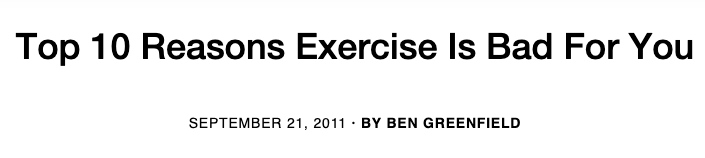
Now, just by reading the title of the article, you may already feel discouraged. But don’t worry! This was written by Ben Greenfield, and by typing in his name in the Google search engine, we can see that he has a Masters’ Degree in Exercise Science and Biomechanics. Upon continuing to read the article, Greenfield isn’t saying that you shouldn’t exercise at all, his main point seems to be that over-exercising, which you should be cautious of, has a lot of drawbacks. He also provides solutions to these drawbacks to help you continue to move! This is a great example of why you should make sure you read the whole article before drawing conclusions on your own.

Instagram: Exercise and Fitness accounts have just grown and grown throughout the years, and while Instagram accounts can be helpful, there are some things you should be aware of. Some accounts may promote different products to boost and improve exercise, which may not provide you with any benefits. Make sure to do some research, just as if you were evaluating a website. You should also be aware that it’s so much easier to photoshop the way people look. If you were looking for certain results, just remember that everyone has different bodies!

Pinterest: Pinterest is filled with so many different ideas for exercise. Some pins can lead to really great sources, but there can be ones that are also just promoting a product for profit. Like Instagram, be aware of this as well!

Reddit: Reddit is a great app for people to share their own experiences of the world around them. But it isn’t the best place for asking about fitness and exercise. Most of the time, the people who are answering your questions aren’t exactly experts. It may be a good idea to stray away from this platform for exercise and fitness.
Overall it may just be a good idea to stay away from these social media platforms, and to lean towards the government websites and reliable articles. They’re usually easy to read and are reliable!
When we think of the word exercise, many of us will probably groan and think of all the time and effort that goes into it. But all of that is just a small price to pay in order to gain life-long benefits. This blog is going to provide you with some tips and tricks on how to squeeze exercise into your life, give you some insight on the benefits of exercise, and overall just help you to Move to Live!
The CDC provides us recommendations on what types of exercise we should do and how long we should do them for. Adults aged 18 and older are recommended to have at least 150 minutes of moderate-intensity exercise each week. This might seem like a lot, but it could really be simply going on a walk or light jog for 30 minutes 5 times a week. Anything that gets your body moving counts! Another recommendation is to do some work to strengthen your muscles at least twice a week. This could simply be doing some push-ups or lifting weights.
According to the National Health Statistics, only about 22.9% of American adults, aged 18-64 met the recommendations above. Overall, we’re not getting as much exercise as we should. However, by meeting these recommendations, you can improve your quality of life!
Here are some reasons why you SHOULD exercise from the Office of Disease Prevention and Health Promotion and the Mayo Clinic:
Not exercising can also put you at higher risk for high blood pressure, high cholesterol, stroke, type 2 diabetes, heart disease, cancer, and many other complications that can negatively affect your quality of life.
Exercise doesn’t have to be difficult or seem like a chore! This blog will help guide exercise into your daily life!
This is an example post, originally published as part of Blogging University. Enroll in one of our ten programs, and start your blog right.
You’re going to publish a post today. Don’t worry about how your blog looks. Don’t worry if you haven’t given it a name yet, or you’re feeling overwhelmed. Just click the “New Post” button, and tell us why you’re here.
Why do this?
The post can be short or long, a personal intro to your life or a bloggy mission statement, a manifesto for the future or a simple outline of your the types of things you hope to publish.
To help you get started, here are a few questions:
You’re not locked into any of this; one of the wonderful things about blogs is how they constantly evolve as we learn, grow, and interact with one another — but it’s good to know where and why you started, and articulating your goals may just give you a few other post ideas.
Can’t think how to get started? Just write the first thing that pops into your head. Anne Lamott, author of a book on writing we love, says that you need to give yourself permission to write a “crappy first draft”. Anne makes a great point — just start writing, and worry about editing it later.
When you’re ready to publish, give your post three to five tags that describe your blog’s focus — writing, photography, fiction, parenting, food, cars, movies, sports, whatever. These tags will help others who care about your topics find you in the Reader. Make sure one of the tags is “zerotohero,” so other new bloggers can find you, too.

 Move to Live