In my last blog post, I wrote about some of the benefits of exercise and how it’s beneficial to your overall health. But you can find tons of information about exercise online. One word searches on Google can get you millions of results. But what information can you trust and what information should you try to stay away from? Here’s a quick guide for you, so you can find reliable sources!
‘MOVE TOWARDS’
Any type of government source is going to be reliable information, so anything you see with “.gov” is one that you should click on! Examples of government sites you should look at are the Centers for Disease Control (CDC) and the National Institutes of Health (NIH). These provides the recommendations for exercise and examples of how you should go about moving!
For other sources of information, like articles, you always want to make sure that the authors are providing you with links to get to other sources. If there are no links, you should look up the name of the author and do a quick little background check. You want to look for their credentials and other types of work they’ve produced!
Let’s look at an example.

This link will take you to an article written by Gretchen Reynolds for the Physical Education column in The New York Times. She provides links to the sources, so you know exactly where her information is coming from. Since her information is coming from Cambridge University, you can consider it reliable.
Sometimes titles can be misleading, which is why you shouldn’t jump to conclusions: Here’s an example of a source you should move towards, but doesn’t seem like it at first:
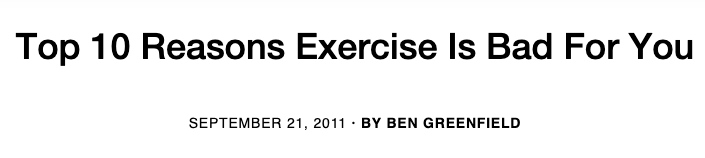
Now, just by reading the title of the article, you may already feel discouraged. But don’t worry! This was written by Ben Greenfield, and by typing in his name in the Google search engine, we can see that he has a Masters’ Degree in Exercise Science and Biomechanics. Upon continuing to read the article, Greenfield isn’t saying that you shouldn’t exercise at all, his main point seems to be that over-exercising, which you should be cautious of, has a lot of drawbacks. He also provides solutions to these drawbacks to help you continue to move! This is a great example of why you should make sure you read the whole article before drawing conclusions on your own.
‘MOVE’ AWAY

Instagram: Exercise and Fitness accounts have just grown and grown throughout the years, and while Instagram accounts can be helpful, there are some things you should be aware of. Some accounts may promote different products to boost and improve exercise, which may not provide you with any benefits. Make sure to do some research, just as if you were evaluating a website. You should also be aware that it’s so much easier to photoshop the way people look. If you were looking for certain results, just remember that everyone has different bodies!

Pinterest: Pinterest is filled with so many different ideas for exercise. Some pins can lead to really great sources, but there can be ones that are also just promoting a product for profit. Like Instagram, be aware of this as well!

Reddit: Reddit is a great app for people to share their own experiences of the world around them. But it isn’t the best place for asking about fitness and exercise. Most of the time, the people who are answering your questions aren’t exactly experts. It may be a good idea to stray away from this platform for exercise and fitness.
Overall it may just be a good idea to stay away from these social media platforms, and to lean towards the government websites and reliable articles. They’re usually easy to read and are reliable!
 Move to Live